

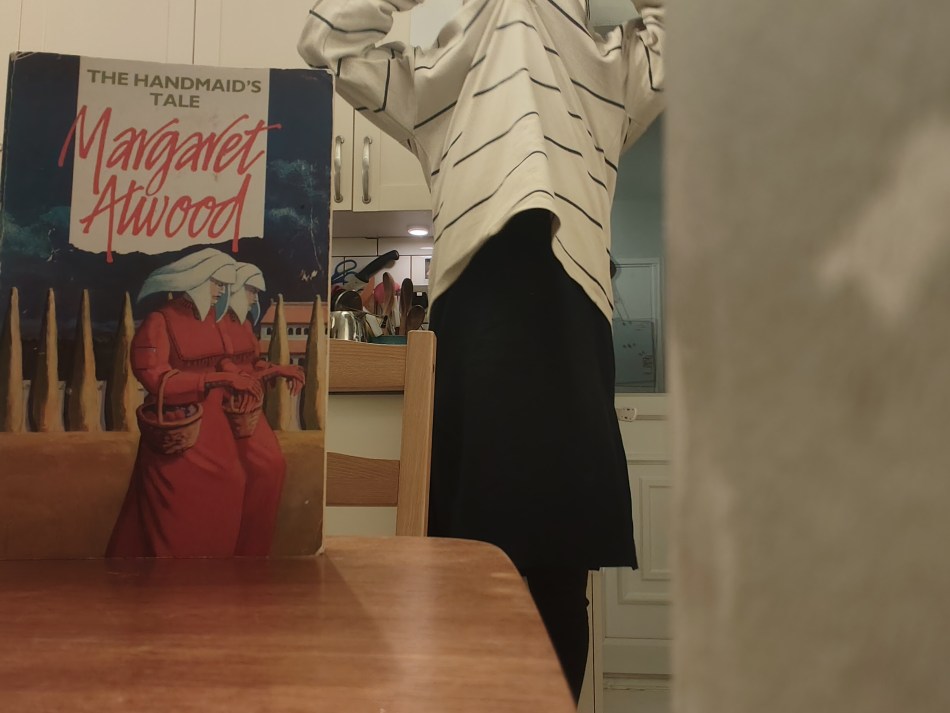
Rereading The Handmaid’s Tale in 2026, to be honest, feels a lot bleaker than it did the last time I looked it over, ten years ago.
In part that is because of the continued rise of fascistic Christonationalists in the United States of America who have rapidly (if steadily) approached and solidified the corrupt and deeply evil politics at the root of their blood-founded, blood-forged and blood-filled country, but also personally because a lot of it is about having a child stolen away from you and now that I’ve got one of those that is more impactul.
I refer not to limits of empathy, no, but to the expansion of it.
Obviously, I understood before that it would be horrible to have a child stolen from you, but my readerly response this time around reminded me of Otis Redding’s cover of ‘(I Can’t Get No) Satisfaction’: while Mick Jagger sings like a man who sometimes can’t get no satisfaction, Redding sings like a man who always can and is riven by sheer terror when imagining having a lack of it. As a person without children, yes, I could imagine it would be bad. But now I’ve got one [that I actively like], I know exactly how that would feel, and it would hurt.
It would be very very bad.
–///–
The Handmaid’s Tale is a 1980s classic.
An international smash hit for a writer who was already by that point a massively acclaimed domestic internal literary superstar. And Atwood has then continued to be a massive deal for decades since, with her many smash novels and with the heavily advertised TV adaptation of The Handmaid’s Tale (which – unless you’re one of the five people in the world who watched it the whole way through, you GENUINELY WILL NOT BELIEVE how long it ran for), the sequel to it she wrote and the (forthcoming? incoming? come?) TV adaptation of that.
This, then, is a novel with a legacy.
Protestors (sometimes socially conservative ones) have used uniforms described in these books when trying to draw attention to societal attitudes towards women, and the very word Gilead – the name of the Christonationalist fascist state that the novel is set in – has been used repeatedly to comment on the ways in which new statutes and changes to laws have (especially in the USA) increasingly removed freedoms and rights from women, though often the people most committed to referencing The Handmaid’s Tale during the last few years have not necessarily been people allied towards united progressive values of wider community and care. And that, yes, is a sweeping generalisation, but an important thing to remember about the world – that I’ve definitely stated here before – is that your enemy’s enemy is not your friend. But it also holds that your enemy’s friend is not necessarily your enemy either.
Just because some people you disagree with like something, doesn’t necessarily mean that thing is bad.
Now, it could be that one party or the other is explicitly misreading that source (an evergreen example of this is people not understanding Starship Troopers), or it could simply be that a text has enough within it to permit multiple readings, to allow a focus on certain sentences or sections to overrule meanings taken from readings centred on passages elsewhere.
This is how Christonationalist fascists – in real life and in Gilead – do Biblical interpretation: all the peace and love and kindness and compassion and Song of Solomon and Psalms-based sensuality stuff is ignored and all of the fire and brimstone, vengeance and cruelty is focused on and quoted without – or with – context.
Leviticus – a quasi-stream of consciousness book that at length contains a list of barely compatible and almost entirely unenforceable rules – can be used to prohibit basically anything. It’s a book (Bible, not The Handmaid’s Tale) that contains so many words and phrases and sentences that it’s possible to make any sentence you want out of cutting it about. And – if literacy is policed and reduced, if access to any forms of unregulated media is illegal and if the ruling autocracy wants to – it’s possible then to edit and rewrite and lie about sources and statements however you want.
The Handmaid’s Tale is full of the results of post-truth, is full of the hypocrisy of elites forcing lives on others they wouldn’t accept for themselves… And it’s also full of Scrabble being used as an erotic buffer, which really isn’t something about the novel I’d retained.
It’s a sickening and cruel dystopia (not because of the Scrabble), a world only significantly different from today due to the escalated decrease in global human fertility. It’s climate fiction, it’s political fiction, it’s feminist fiction, it’s fiction about white supremacy, about historical revisionism, about misogyny, about cruelty and about hatred that never chooses to openly accept that hatred is what it is.
Atwood’s prose hums and her descriptions are clear and vivid. Re-reading this almost immediately after Hemingway’s The Old Man and the Sea, this offers a great counterpoint to the Hemingwayesque notion that subtext is the best text… Atwood gives you EVERYTHING here: the history of her dystopia in a personal and national mode, she tells us how things have happened and when and who to. She tells us – with her tight tight tight and deeply realised first person narrator – exactly what feelings are felt when and how. And this is something that, ordinarily, would be seen as making a novel or a work of fiction fail as an imaginative text for its readers. But it simply isn’t the case: there isn’t really much space to misimagine the world that’s created here, and that isn’t remotely limiting: there is a depth and a complexity and a world-ness to Atwood’s awful world that makes it a novel that’s very hard to look away from while you read.
It sinks into your dreams and your conversations, it seeps into the sociocultural consciousness; it’s been adapted more than once for visual media and it almost certainly will be again. The terror of a misgynistic autocracy is one that has been realised in multiple places around the world at several different times, and it’s not impossible – especially now – for it to happen in places that once seemed “free[r]” of that risk.
It holds up, it refines, it continues to develop over time.
A modern classic deserving of the title.
Well worth the time it takes to re-read…

Thank you so much for reading TriumphoftheNow.com! If you like what you’ve read, please subscribe, share and order one of my books. If you love what you’ve read, why not order me something frivolous and noisy from this Amazon wishlist or make a quick donation via my ko-fi page?
I’m currently focusing on parenting and creative practice, so small donations are appreciated now more than ever!
scott manley hadley aka SOLID BALD live
Here’s a video of me recently performing at the prestigious (it has a Wikipedia page) comedy night, Quantum Leopard. Listen to how much fun the crowd is having. You could have that much fun, too!
Forthcoming gigs include the following – there may/will be others:
21st September: West End New Old Act of the Year HEAT, near Goodge Street
5th October: The Defectors present Scratch ‘N’ Sniff at Bread & Roses, part of the Lambeth Fringe
15th October: The Bar VXXXII Comedy Club, Colchester
26th October: Alternative Comedy Jam, Brighton
29th October: The Comedy Centre, Isleworth
5th November: Isle of Wight
21st November: Twinkles Cabaret, London
13th December: Dr Mew’s Sci-Fi Cabaret, Aces & Eights, Tufnell Park
7th January 2027: I’ve got something in the calendar for this but no details
10th March 2027: Lydford, Devon
Discover more from Triumph Of The Now
Subscribe to get the latest posts sent to your email.


0 comments on “Re-reading The Handmaid’s Tale by Margaret Atwood”