
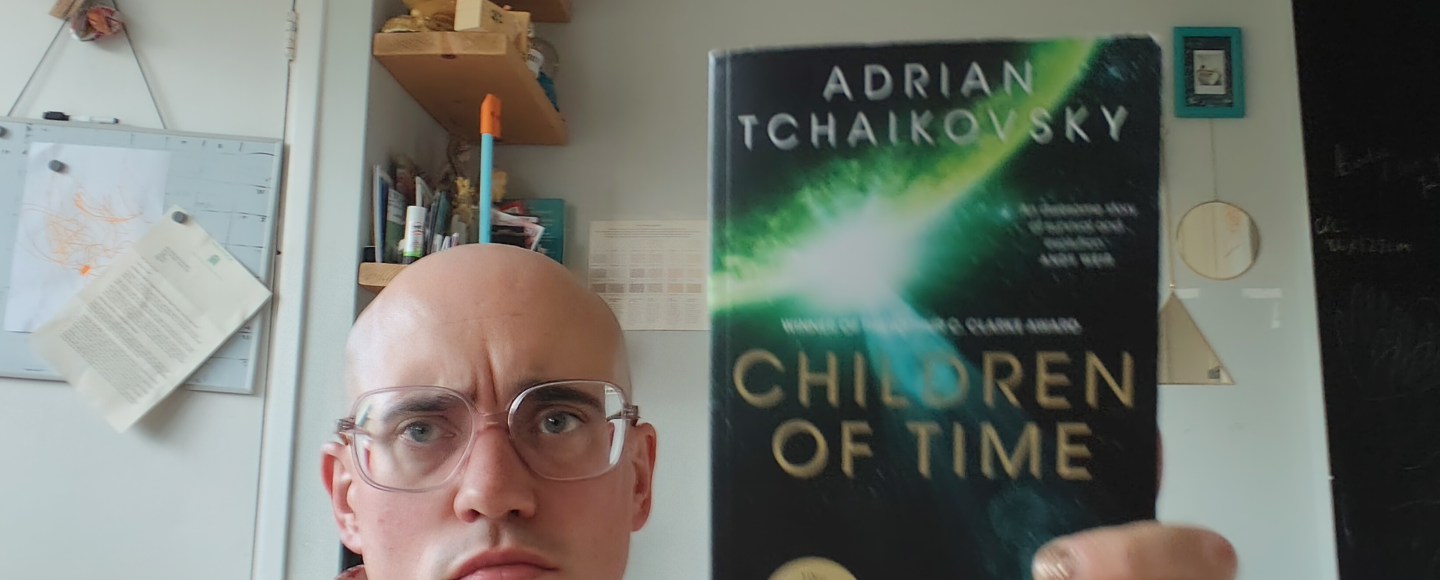

The last time I was in Toronto (for a wedding in the Spring; I didn’t make it there during my more recent Canadian trip for a funeral) I visited Bakka-Phoenix, a world-famous-in-Canada (and wherever a Torontonian (or Torontophile) is interviewing Guillermo del Toro, who allegedly makes a habit of recommending it) sci-fi and fantasy specialist bookstore.
Now continuing to too-frequently delve into that genre (it’s a sign of an arrested mind, a stalled personal development, a deliberate decision to swerve serious and important thoughts and conversations and feelings, which other books force upon an engaged reader, which maybe means I’ve stopped being an engaged reader and if I’m not an engaged reader any more, then what really am I?), but still being a relative newcomer to its escapist charms, I asked the person behind the desk (should one call them a “bookseller”?) if they could recommend me – and my spouse, for she too was there – something to read that we would both enjoy.
We spoke for several minutes about what we enjoy, what we don’t enjoy and what we were hoping to get from a novel1. After a few suggestions – many of which were things we’d already read and – crucially – liked, we landed on a recommendation for Adrian Tchaikovsky’s Children of Time, which I had never heard of, but it won some major SF awards when published about a decade ago. There are a couple of sequels (maybe more, though maybe not), which was offered by the bookseller as a positive; if you like it, there’s more etc.. It sounded intriguing, it sounded interesting, and so we were sold.
My spouse read it before me, while grieving in July.
One of the blurbs on the back of the book describes it as “the greatest evolutionary world-building ever written” (check that) and my partner’s recurring comment post-reading the book (to me and to others) was: “I didn’t know what that meant, but having now read it, it definitely is the greatest evolutionary world-building I’ve ever read.”
I took the copy of this big book with me when I went to Edinburgh for my week and a bit of self-actualising/self-deluding (delete as appropriate to your level of cynicism and/or cruelty) at this Summer’s Fringe festival.
I scooted around the city from gig to performance to show (watching, singing, reciting, talking etc.) with Children of Time in my orange jacket’s giant pockets whenever they weren’t stuffed with too many flyers (I do have slightly more of these left than I’d hoped to – please reach out if you’d like a set of flyers advertising a show that took place in the past), and I read it in fits and bursts, usually before falling asleep (this was the longest stretch of sleeping alone in the same bed I’ve had since the Summer of 2018, and I’d forgotten the joy that can be found in reading abed until the moment you are ready to fall asleep (as someone who sees no value or validity in themselves and their joys, using a light in a room that someone else is sleeping in has always felt like something inappropriate, unacceptable and selfish to do (Christ I need to fucking get a bit more self-respect)).
I loved it, I enjoyed it very much.
As I carried it about, reading as I walked (when else does a person accidentally living in a society that permits minimal time for anything “unproductive” read if they haven’t mastered this – to my mind – absolutely essential lifeskill?), when I arrived to my many destinations, people (peers/rivals/strangers/flyerers) would often ask me what I was reading.
Less depressed than I am in my deeply unsatisyfing and functionally pointless life in London (the go-to questions at the Edinburgh Fringe don’t force an immediate confrontation on the fatuousness and sunk-cost depressive nature of ones broken and failed economic life choices), I found this far less of a bore than it would be down in the South.
And also there’s a presumption of shared values between performers and attendees at weird comedy shows in the Edinburgh Festival that means you’re not about to accidentally be exposed to hatefulness.
Essentially, everyone I spoke to about Children of Time had either read it and loved it, thought it sounded great, or thought they were too cool for SF (which, in a way, I am, actually).
And that isn’t because I’m an enthusiastically evangelical reader of Adrian Tchaicovsky, but because the novel’s presmise (and, tbf, being less ground down by routine meant I probably did come across as more enthusiastic than I ordinarily do (because ordinarily I’m barely enthusiastic about anything except the pleasing inevitability of death)2) is just so fucking good.
Essentially, this is a really cracking, really fun, really well-executed millennia-spanning space opera. It promises and offers a great read and it absolutely delivers. It plays with the passage of time, with key characters in and out of deep sleep across a long space voyage; others are born and die in numerous generations alongside them, sometimes seen once and gone, sometimes persisting across many chapters of the book before the other people slip back into their sleep pod and wake up again in a different existence.
What I’m trying to say is that it does exactly what it promises to do, and it does it well.
So, if you don’t want to see a synopsis, stop now.
–///–
A long way in humanity’s future, we have obtained the ability to travel interstellar distances.
We have developed the technology to terraform planets to make them liveable.
We have developed gene editing to the point where we can – and do – create anything that we want.
We have also continued to produce massive amounts of very toxic pollution, so the terraforming has become more urgent. And/But the gene editing has become the main focal point of debate and discussion and tension in society, and huge, violent, clashes are happening more and more between the people who want to use gene editing to solve all humanity’s problems, and the people who think we must leave everything as it [once] was. Those against the mainstream techno-scientific establishment get better and better and more effective at sabotage and terrorism and, eventually, one of them makes an attack on one of the terraforming stations, a long way from Earth.
On this planet, a scientist (sinister, for sure), is planning to try to force the rapid evolution of a new type of humanity. The planet – made liveable, seeded with plants and a variety of small animal life – is about to receive a payload of loads of chimps, who will then be infected with a nanovirus that will supercharge intelligence, collaboration and physical evolution. However, in the sabotage of this project, the chimps are all killed, every single human in the vicinity is killed bar one, and only the scientist leading the project survives, and she does so by sprinting to the observation pod set up to monitor the chimp’s evolution with a human expected to stay in deep freeze until evolution had made intelligent life. Oh, and the nanovirus survives and drifts down to the ground, infecting the most intelligent species deposited on this Earth 2.0… and those are spiders.
Back on Earth, war erupts, and a hostile computer virus is sent out across all of the known universe that turns off almost every single machine in existence, causing the immediate collapse and mass death of pretty much every single space colony, space station and person on a space ship (there are some very rare exceptions, including the scientist who planned to observe her rapidly evolving chimps).
Industrialised society collapses, mass extinctions occur and huge swathes of the human population die, with technology all but unuseable. Time passes, a mass ice age forces the remaining human population towards the equator and underground, and over thousands of years, technology again reaches the level of space travel, though at slower speeds than the previous technology allowed, and much of the understanding and technology that exists is based on partial understanding of the remnants of the previous space-spanning empire.
Then, alas, the ice over most of the planet begins to melt, and all of the toxins and poisons of the industrialised world begin to ooze out, increasingly making Earth uninhabitable. Ark ships are built, thousands of people are put into deep cryogenic sleep on them, and they head out towards the rumoured and potentially terraformed planets out there in deep space.
The ark ship our protagonists ride – the Gilgamesh – has lost all contact with Earth, with other Ark ships, so presumes it must be the last one left, humanity’s last hope… And when they arrive at their Terraformed destination, hundreds of years further into the future, they find it peopled not by friendly apes (or nothing), they instead discover it full of giant spiders, protected by a hostile and (it turns out) heavily armed satellitie controlled by the eroded combination of a thousands-of-years-old scientist and the AI copy of her brain she created and uploaded deep in the past.
More time passes; the spiders and their society and technology grows in complexity; and hope, for the humans, dwindles, as they look for places elsewhere that might make a survivable home with no luck…
And that’s it, that’s the overall premise; humans from the second societal discovery of space travel raging against giant spiders for (possibly) the only liveable planet in the entire universe.
Is it metaphor? Is it blunt, unmetaphoric cli-fi looking at what will happen if/when it becomes clear that technology cannot and will not fix the environmental calamities happening all around us due to the ravages of human-made climate change?
Is it a rip-roaring yarn about space travel, the passage of time, the erosion of hope and the realisation of the deep and precariously unfixable problems of this consumerist, capitalistic society that we’ve all ended up in, most of us without ever consenting or choosing to do so?
(Yes to both.)
It’s witty in places, its characters are well drawn and rounded (both human and spider) and there is real emotional lurch in the peril and the swift movement though time.
The main voice on the Gilgamesh the narrative follows is the ship’s Classicist, an expert on the “Old Empire” who’s brought out of deep freeze every time evidence of previous human presence is found (a distress beacon, a space station), or data previously found at one of these sites requires deeper or renewed analysis. He starts as one of the oldest people on board, though as time spent in deep sleep does not align between the various factions, this isn’t the case for long.
Children of Time is a novel that’s playful with time, and though its structure is in chronological order, the leaps and jumps forward, ceaselessly forward, means it in no way feels staid or typical.
I enjoyed it a lot, and though my spouse was less enthusiastic about the sequel to it that she read immediately afterwards, two of the strangers I spoke about the book with in Edinburgh told me they’re just as good, so I will come to that, eventually. Soon, I suppose.
Though I really need to read some books for real adults again soon. My self-respect is rock bottom and, Christ, I do need to try to address that at some eventual point.
But not today, not this week, not this month and probably not this calendar year.
Expect some miserable posts over the next few months, as I’ve made a pragmatic decision that may well cause severe unhappiness in the short term. Or maybe not, maybe I’ll be lucky and all will be smooth. Let’s all find out together.
It’s not Triumph of the When, is it? It’s Triumph of the Now. I had 10 days in Edinburgh living in the now, living a real life that felt like it had meaning. For a while, that’s unlikely to be the case. But we’ll ride through it, smooth, eternal, ceaseless.
Thank you.
- There’s a similar one of those SF and fantasy bookstores in Edinburgh, actually, which I visited while there to do the same thing, however as soon as I said something I didn’t love (as opposed to things that I do), the shop assistant basically stopped being helpful (the writer I said I didn’t love was M. John Harrison, though I phrased it as saying “I always like the idea of his work, but rarely enjoy the actual experience of reading it,” which the guy seemed to take as a personal attack…) ↩︎
- Maybe I’ve stated this on the blog before, but unless I’m actively talking about trying to figure out how, financially, to get laser eye surgery on a near-daily basis, then I am actively, constantly, yearning for death. Namaste. ↩︎

Thank you so much for reading TriumphoftheNow.com! If you like what you’ve read, please subscribe, share and order one of my books. If you love what you’ve read, why not order me something frivolous and noisy from this Amazon wishlist or make a quick donation via my ko-fi page?
I’m currently focusing on parenting and creative practice, so small donations are appreciated now more than ever!
scott manley hadley aka SOLID BALD live
Here’s a video of me recently performing at the prestigious (it has a Wikipedia page) comedy night, Quantum Leopard. Listen to how much fun the crowd is having. You could have that much fun, too!
Forthcoming gigs include the following – there may/will be others:
15th October: The Bar VXXXII Comedy Club, Colchester
18th October: Brockley
19th October: West End New Old Act of the Year Semi-Final
26th October: Alternative Comedy Jam, Brighton
29th October: The Comedy Centre, Isleworth
21st November: Twinkles Cabaret, London
7th December: Coherent Comedy, Online
13th December: Dr Mew’s Sci-Fi Cabaret, Aces & Eights, Tufnell Park
7th January 2027: I’ve got something in the calendar for this but no details
10th March 2027: Lydford, Devon
Discover more from Triumph Of The Now
Subscribe to get the latest posts sent to your email.


0 comments on “Children of Time by Adrian Tchaikovsky”